
Drug Testing for Law Enforcement Agencies
Pre-employment, random, fitness-for-duty, and reasonable-suspicion testing for sworn officers and corrections personnel — plus high-volume kits for field operations and intake.


The Law Enforcement Testing Challenge
Law enforcement agencies run testing in two distinct contexts: testing the officers themselves and testing the people in their custody. The officer-testing side is governed by collective bargaining agreements, civil-service rules, state POST commission requirements, and reasonable-suspicion procedures that have to hold up under union grievance and arbitration. The custody-testing side covers jail intake screening, work-release verification, and (in agencies operating their own pretrial supervision) court-ordered probationer testing. Most agency procurement processes treat these as two separate purchases — different vendors, different account contacts, different price negotiations — even though the products are largely the same.
The supply problem is recognizable to anyone who's done municipal procurement: a multi-year contract was awarded to one vendor in 2019, the vendor has slowly raised prices and degraded service since, but the procurement office hasn't re-bid because the renewals are auto-extending and nobody's complaining loudly enough. Meanwhile a smaller sheriff's office in the next county over is paying 40% less because they re-bid two years ago. Pricing for instant cups should reflect commodity-tier market dynamics; in too many agencies it doesn't.
Panel design also lags. Standard 5- and 10-panels were appropriate when they were designed; current jail intake populations have substantial fentanyl exposure, K2/Spice and other synthetic-cannabinoid use, kratom, and gabapentin use that won't show up on a panel designed in the early 2000s. Agencies serving regions with significant fentanyl-driven overdose mortality should be using cups that include fentanyl on the same panel, with separate fentanyl and xylazine single-strip tests available for harm-reduction overdose-prevention work in the jail context.
How Magenta Helps Law Enforcement Agencies
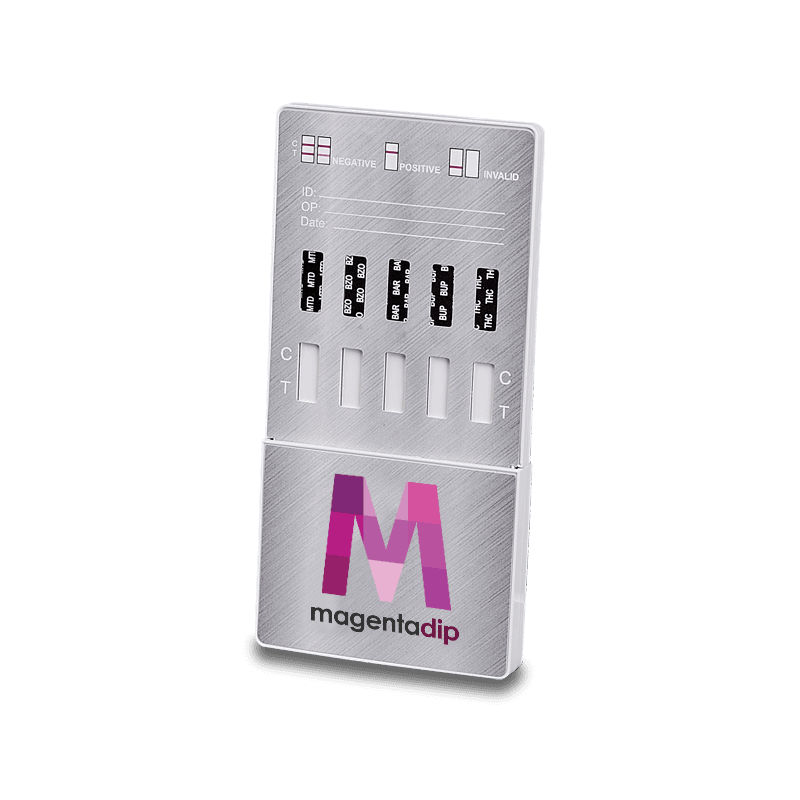
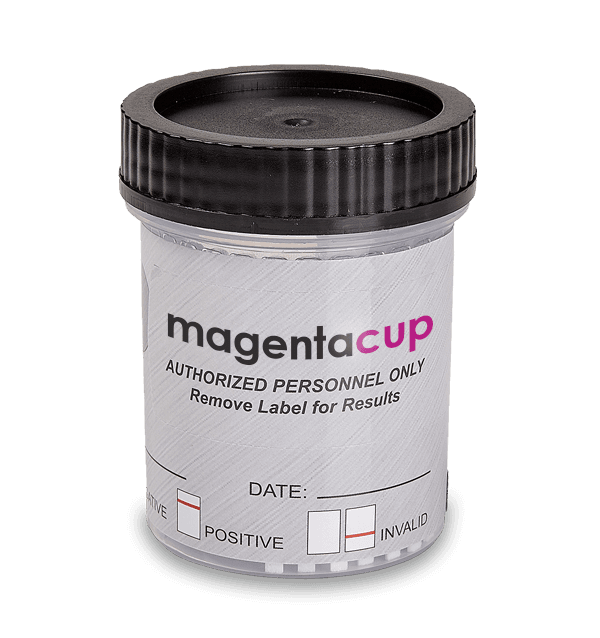
Magenta supplies law enforcement agencies with the cup panels both sides of the operation actually need. For sworn-officer pre-employment, random, and reasonable-suspicion testing, our 10-panel CLIA-waived dip card and 12-panel CLIA-waived cup cover the standard SAMHSA-5 plus benzodiazepines, methadone, oxycodone, MDMA, and barbiturates — appropriate for the panel most municipal collective bargaining agreements specify. For agencies that have updated their MOU to add fentanyl, our 13- and 14-panel cups handle that on the same SKU.
For jail intake and custody-side testing, the same 12-, 13-, and 14-panel cups are designed for high-throughput use — drug-screening at booking, periodic during longer stays, prior to work-release. Agencies serving regions with documented fentanyl overdose mortality typically standardize on the 13-panel with fentanyl as the intake cup and stock fentanyl single-strip tests for harm-reduction conversations with arrested individuals at risk for overdose on release. For agencies running their own probation or pretrial supervision, the same kit lineup supports court-ordered field testing — see our probation and drug-court page for the supervision side of that workflow.
Operationally, we are set up for municipal and county procurement realities. Wholesale tiered pricing reflects actual agency volumes. NET 30 invoicing on approved governmental accounts is standard, and we work with procurement offices on W-9, certificate of insurance, and any other vendor-onboarding documentation required. Same-day shipping on orders placed before 3pm ET on any in-stock SKU means a jail that runs short on intake cups Friday has them Monday — without overnight rush charges. For agencies on cooperative purchasing contracts, we work with the state contract structure to honor whichever pricing mechanism the agency procures through.
We also supply chain-of-custody forms for any test that may end up in court — internal supervision-program forms for routine custody-side testing and forensic COC documentation for officer-side reasonable-suspicion testing or any test that will go to a reference lab for confirmation. For agencies that confirm everything at a state-contracted lab, we supply kits-only at the same wholesale pricing.
Recommended Products for Law Enforcement
The panels and form factors law enforcement order most.
Compliance Considerations for Law Enforcement Testing
Law enforcement testing operates under multiple overlapping authority structures. Sworn-officer testing is governed by the agency's collective bargaining agreement (where applicable), civil-service rules, state Peace Officer Standards and Training (POST) commission requirements, and the agency's own written testing policy. Reasonable-suspicion testing of sworn officers is one of the most legally contested areas of public-sector employment law — the supervisor making the call needs documented training, the basis for the test needs to be specific and articulable in a written record, and the testing procedure has to follow the policy precisely or the result is likely to be excluded at arbitration.
Pre-employment testing of police candidates is typically the most legally settled application — conducted after a conditional offer, made contingent on a negative result with the candidate informed in writing. State POST commissions in many states either require or strongly recommend pre-employment drug testing as part of the certification process. Random testing of sworn officers is more contested in some jurisdictions — courts have generally upheld random testing of safety-sensitive positions but the specific selection methodology and the agency's written policy matter.
Custody-side testing — drug screening of arrested or incarcerated individuals — has different legal authority and different practical considerations. Booking-area drug screening is generally permitted as part of intake medical screening but is governed by jail medical-care standards (NCCHC, ACA accreditation) rather than employment law. Results inform medical care decisions (assessing overdose risk, medication-assisted treatment eligibility) and may inform classification decisions. Pre-release testing for individuals re-entering the community is increasingly common for jurisdictions linking jail release to community-based treatment or supervision.
Confidentiality treatment varies significantly. Sworn-officer testing records are typically treated as personnel records subject to state public-records exemptions for confidential personnel information. Custody-side testing results are jail medical records subject to HIPAA (and 42 CFR Part 2 where SUD treatment is involved). Reference-lab confirmation results are subject to the lab's records-retention and disclosure policies. Agencies should have written records-handling procedures aligned with state public-records law and applicable federal confidentiality regulations.
Key regulations and standards
- Collective bargaining agreements — Officer testing terms — pre-employment, random, reasonable-suspicion, post-incident — typically negotiated in CBAs.
- State POST commission rules — Peace Officer Standards and Training requirements vary by state; many include pre-employment drug testing for certification.
- Garrity / Loudermill protections — Sworn-officer due-process protections relevant to testing programs that may lead to discipline.
- Jail medical standards (NCCHC, ACA) — Custody-side intake medical screening including drug testing operates under jail accreditation standards.
- HIPAA / 42 CFR Part 2 — Custody-side medical and SUD treatment records subject to federal confidentiality protections.
- State public records / personnel records law — Disclosure and retention of officer testing records governed by state-specific records law.
Law enforcement testing requirements vary significantly by agency type, jurisdiction, collective bargaining agreement, and state POST regulations. This information is for general guidance only — consult agency counsel and your state POST commission for specific requirements.
"Law enforcement agencies consistently tell us the same thing: procurement got locked into a vendor years ago, prices crept up while service degraded, and nobody re-bid because it wasn't burning. The agencies that do re-bid typically find 30 to 40 percent savings on instant cups at current commodity pricing — and they typically consolidate sworn-officer testing and custody-side testing onto one wholesale account instead of running two separate procurements."
Frequently Asked Questions
Do you work with municipal and county procurement processes?+
Yes. We provide W-9, certificate of insurance, vendor questionnaires, and any other documentation your procurement office requires for vendor onboarding. NET 30 invoicing is standard on approved governmental accounts. We can work with state cooperative purchasing programs where your agency procures through one.
Can one account cover both officer testing and custody-side testing?+
Yes — and most agencies prefer that arrangement. One wholesale account, one rep, one invoice, with sub-account shipping if officer testing and jail intake testing ship to different addresses within the agency. Wholesale tier is set against combined agency volume, which is typically meaningfully better than running two separate accounts at lower individual volumes.
What panel should we use for officer pre-employment testing?+
Most agencies use a 10-panel CLIA-waived dip card or 12-panel cup for officer pre-employment, covering SAMHSA-5 plus benzodiazepines, methadone, oxycodone, MDMA, and barbiturates. The specific panel should match what your collective bargaining agreement or written policy specifies. Some agencies have updated to a 13-panel that includes fentanyl; check your CBA before changing panel composition.
What about reasonable-suspicion testing?+
Reasonable-suspicion testing of sworn officers is one of the most procedurally exposed areas of officer testing. The supervisor making the call needs documented training, the basis needs to be specific and articulable in a written record, and the procedure has to follow your written policy precisely. The instant-cup positive should always be lab-confirmed by GC-MS or LC-MS-MS with documented forensic chain of custody before any disciplinary action. We supply forensic COC forms and partner with accredited labs for confirmation.
Is fentanyl on your cups?+
Yes — our 13-panel and 14-panel cups include fentanyl as a dedicated analyte. Fentanyl does not cross-react with the standard opiate immunoassay, so a panel without dedicated fentanyl screening will miss most fentanyl use. Agencies serving regions with documented fentanyl overdose mortality should consider fentanyl-inclusive panels for both officer testing (if CBA allows) and custody-side intake screening.
Do you supply harm-reduction strips for jail re-entry?+
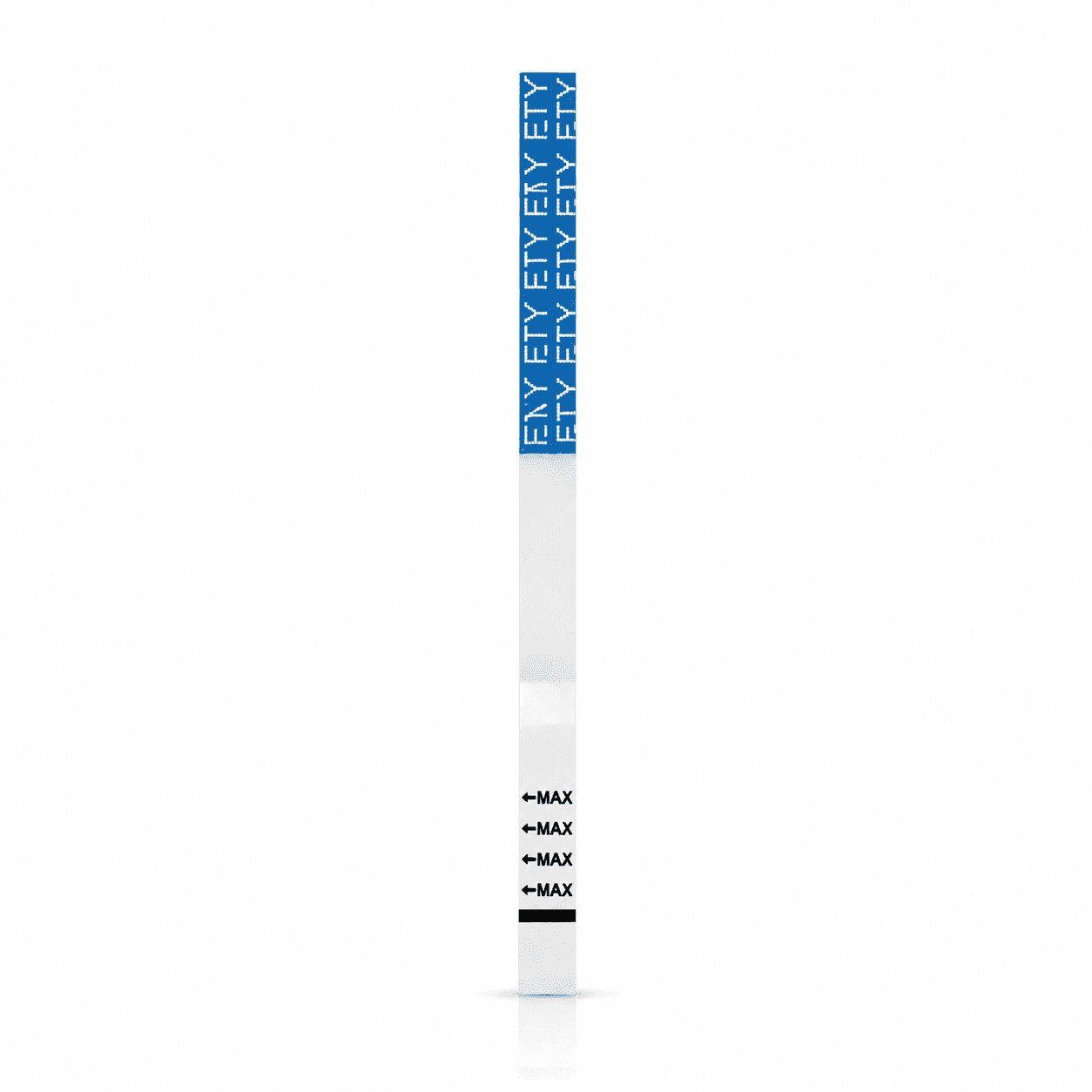
Yes. Our fentanyl single-strip and xylazine single-strip tests are stocked specifically for harm-reduction overdose-prevention contexts. Agencies using them as part of re-entry counseling for individuals released from jail with recent opioid-use history typically distribute them alongside naloxone training. These are not CLIA-waived for clinical decision-making in most jurisdictions but are useful for the harm-reduction conversation.
How quickly can you ship for a high-volume order?+
Same-day shipping on orders placed before 3pm ET on any in-stock SKU. For large orders (1,000+ cups), production lead time may add 1 to 3 days if existing inventory doesn't cover the order. For planned annual orders that run into the tens of thousands of units, we can produce against a forecast and stage shipments to the agency's preferred receiving cadence.
What's the minimum order quantity?+
There is no minimum to open a wholesale account. Tiered pricing kicks in at 100 units of a SKU and scales at 500 and 1,000+. Most law enforcement agency orders qualify for the second or third tier on first order — even small agencies typically order in 500+ unit increments when consolidating officer and custody testing.
Ready to Re-Bid Your Testing Program?
Wholesale pricing, governmental NET 30 terms, sub-account billing for officer-side and custody-side use cases, and fentanyl-inclusive panels designed for current drug trends.
Related Industries
Probation & Court-Mandated
Chain-of-custody-ready testing supplies for probation, drug courts, and supervised release programs.
Explore →Government & Military
Federal Drug-Free Workplace Program supplies for government agencies, contractors, and military commands.
Explore →DOT Transportation
49 CFR Part 40-compliant testing supplies for commercial drivers and safety-sensitive roles.
Explore →Hospitals & Medical
Staff testing, emergency-department toxicology, and outpatient-clinic supplies for hospitals and medical facilities.
Explore →