
Drug Testing Supplies for Rehab Centers
FDA-cleared, CLIA-waived kits built for the volume, accuracy, and chain-of-custody needs of addiction treatment programs.

The Rehab Center Drug Testing Challenge
Addiction treatment programs run on accurate, frequent, and defensible drug testing. A residential program may test every patient on intake, randomly throughout the week, after every off-site pass, and again at discharge. An intensive outpatient program may test 100 to 300 patients per month. The volumes are large, the budgets are tight, and the consequences of a missed positive — or a false positive — are real: discharge decisions, level-of-care changes, and in some cases, court reports.
The supply problem most treatment programs describe is the same. They are paying retail or near-retail prices for cups that should be priced as commodities. Their distributor sends 50 different SKUs and they can never remember which one is the 12-panel with adulterants and which is the 10-panel without. Backorders happen at the worst possible time. The chain-of-custody forms come from a different vendor than the cups, and the lab uses a third form. And the staff who actually run the tests — counselors, techs, nurses — never get a clear in-service from the supplier on how to read a faint line.
Programs also need their cups to do more than screen for drugs. A patient population that includes people early in recovery, under court mandate, or facing high-stakes clinical decisions means specimen validity matters. A panel without built-in adulterant detection (creatinine, pH, oxidants) leaves the program exposed to results that may not reflect the actual specimen. Cups with integrated adulterant strips close that gap on the same workflow — no separate step, no separate SKU, no separate inventory line.
How Magenta Helps Rehab Centers
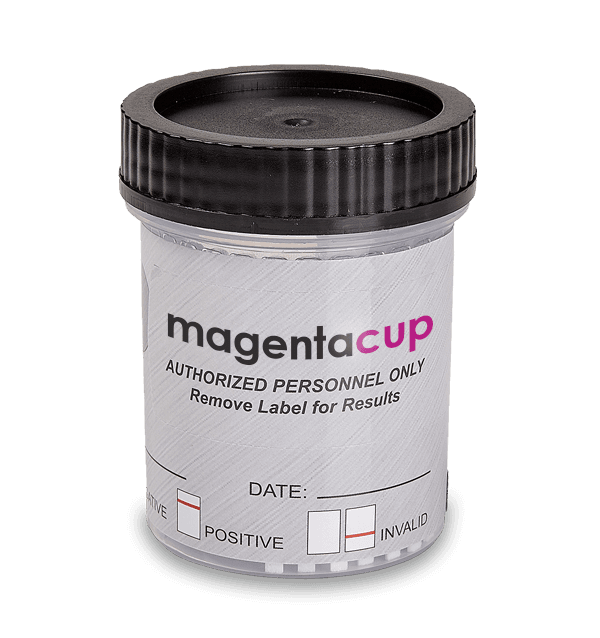
Magenta sells the kits that treatment programs actually use, at volumes that actually reflect treatment-program math. Our 12-panel CLIA-waived clicker cup with three adulterant strips is the workhorse for residential and IOP settings: it screens for the standard SAMHSA panel plus benzodiazepines, oxycodone, methadone, buprenorphine, MDMA, and tricyclic antidepressants, and flags creatinine, pH, and oxidants on the same cup. That is one SKU, one in-service, one workflow.
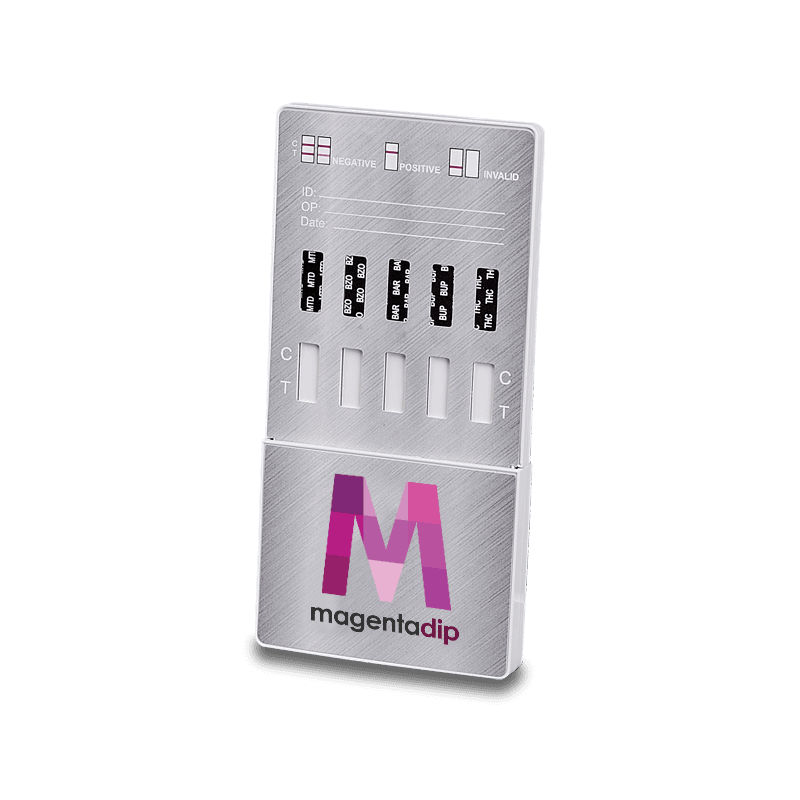
For programs that need a smaller footprint or a tighter price per test — sober living houses inside a larger continuum, scholarship beds, intake screens before a full panel — our 10-panel dip cards bring the per-test cost down without giving up CLIA-waived status. For specimen validity on the rare specimen that looks suspicious, adulteration test strips ship separately and let the tech confirm in 60 seconds.
On the program-operations side, we are set up for the way clinical buyers actually purchase. NET 30 terms are available after a one-page application and a quick credit check, so the clinical director is not putting $2,000 of kits on a personal card while accounting processes a check. Wholesale tiered pricing scales automatically with quantity — the same SKU is priced differently for the program ordering 200 cups a month than for the one ordering 2,000, and the discount applies at checkout without an email back-and-forth. Tax-exempt accounts upload a certificate once and the cart drops to zero tax forever.
Same-day shipping on orders placed before 3pm ET means an emergency reorder on Wednesday morning arrives Thursday. Most programs end up ordering monthly on a standing schedule once they trust the inventory; for those that prefer it, we can set up a recurring subscription with an additional 5–10% discount that auto-ships on the cadence the program picks. The most common comment we get from clinical directors at the 6-month mark is that they stopped thinking about cup supply.
Recommended Products for Rehab
The panels and form factors rehab centers order most.
Compliance Considerations for Rehab Centers
Treatment programs operate in a layered regulatory environment. State licensure rules govern most of the day-to-day testing protocol — frequency, observed-collection requirements, how positives must be documented in the patient record, and what triggers a level-of-care change. CARF and Joint Commission accreditation standards add documentation requirements on top of state rules, especially around chain of custody, staff training, and the handling of laboratory-confirmed results. Programs receiving block-grant or Medicaid dollars often have additional state-specific drug-testing performance measures tied to reimbursement.
On the patient-privacy side, 42 CFR Part 2 — the federal regulation that governs the confidentiality of substance-use-disorder treatment records — is stricter than HIPAA. Drug test results are SUD treatment records under Part 2 and cannot be released to courts, employers, families, or even other providers without a specific written consent that meets Part 2's requirements (or one of the narrow exceptions, like a medical emergency or a court order that specifically addresses Part 2). Programs that fax or email results need to confirm their workflow holds up under both HIPAA and Part 2.
For programs that submit specimens to a reference laboratory for confirmation (typically GC-MS or LC-MS-MS), the chain-of-custody form is the single most important document. It establishes who collected the specimen, when, where, that the temperature was within range, that the seal was intact at the lab, and that no one in between had unmonitored access. For specimens that may end up in a legal proceeding — drug court reports, custody evaluations, employer reports under a release — programs typically use the forensic chain-of-custody form preferred by the supervising court or receiving entity.
Instant point-of-care results from a CLIA-waived device are screening results, not confirmed results. Programs should have a written policy that distinguishes between a presumptive positive on a cup and a laboratory-confirmed positive, with clear rules about which clinical decisions can be made on a screen alone (counseling response, level-of-care meeting) versus which require lab confirmation (discharge, court report). The CLIA certificate of waiver itself — required to perform even waived testing in a clinical setting — needs to be current and posted, and the staff performing the tests need to be trained per the manufacturer's instructions for use.
Key regulations and standards
- 42 CFR Part 2 — Federal confidentiality of substance-use-disorder treatment records — stricter than HIPAA.
- CLIA Certificate of Waiver — Required to perform waived testing in a clinical setting; must be current and posted.
- CARF / Joint Commission — Accreditation standards around chain of custody, staff training, and result documentation.
- State licensure rules — Govern testing frequency, observed-collection requirements, and positive-result protocols.
- SAMHSA CCF (Federal Custody and Control Form) — Court-recognized chain-of-custody form for legally defensible specimens.
Information provided for general guidance only. Compliance requirements vary by state, accreditation body, and payer. Consult qualified legal counsel and your accreditation body for specific requirements applicable to your program.
"Customers in addiction treatment consistently tell us the same thing: they were buying cups from two or three different distributors, paying near-retail per unit, and losing half a day a month to backorders. Consolidating onto a single SKU — the 12-panel cup with adulterant strips — at a wholesale tier, with predictable shipping, recovers both the per-test cost and the clinical-director hours."
Frequently Asked Questions
Do you offer chain-of-custody forms?+
Yes. Standard 5-part forensic chain-of-custody forms ship with most lab-confirmation orders, with formats appropriate for specimens that may end up in a legal or court-reported context (drug court reporting, custody evaluations, employer reports under a release). Custom-branded forms with your program's name and contact information are available on bulk orders — contact our wholesale team for a quote.
What's the minimum order quantity for rehab pricing?+
There is no minimum to open a wholesale account, but tiered pricing starts at 100 units of a single SKU and scales meaningfully at 500 and 1,000+. Most residential programs in the 30–60 bed range qualify for the first or second tier on their first month's order. We can put together a custom quote for any program ordering 500+ cups per month — including blended SKU pricing if you mix 12-panels with dip cards.
Can I set up a recurring subscription so I don't have to reorder?+
Yes — once your wholesale account is approved, you can set up a recurring order at weekly, biweekly, or monthly cadence directly from your account dashboard. Subscriptions get an additional 5–10% off our already-discounted wholesale pricing. You can pause, skip, or change quantities anytime without contacting support.
How fast does shipping take?+
Orders placed before 3pm ET ship the same business day from our facility. Standard ground delivery is 1–3 business days for most addresses in the continental US; expedited (2-day) and overnight options are available at checkout. We do not store inventory in regional warehouses, so transit time is purely carrier transit time — no fulfillment lag.
Do your cups test for fentanyl?+
Yes. Our 13-panel CLIA-waived cup includes fentanyl alongside the standard SAMHSA-5, benzodiazepines, methadone, buprenorphine, oxycodone, and MDMA. If you need fentanyl screening but want to keep cost down, fentanyl-specific dip strips are also available and can be run from the same cup specimen.
How do I handle a faint or barely-visible line?+
Any visible line in the test region — even a very faint one — is a negative result for that analyte. Drug test immunoassays are designed so that any drug-metabolite presence above the cutoff produces no line, and any concentration below the cutoff produces a line of varying intensity. Train staff that line intensity is not a measure of how much drug is present. Send any specimen with a missing line (a presumptive positive) to a reference lab for confirmation before making a clinical decision that affects level of care or discharge.
Are your tests CLIA-waived?+
All of our urine cup and dip-card panels are CLIA-waived under 42 CFR 493.15 — meaning they can be performed in any setting with a current CLIA Certificate of Waiver and do not require a high-complexity laboratory. You will need a valid CoW on file, and staff performing the tests must be trained per the manufacturer's instructions for use.
Do you offer custom branding on the cups themselves?+
Custom-printed labels on the cup body are available for orders of 5,000+ units. Most programs find that custom-branded chain-of-custody forms (available at lower minimums) deliver the professional appearance they want at a fraction of the unit cost. Contact our wholesale team to discuss what makes sense for your program.
Ready to Stock Up?
Get bulk pricing, NET 30 terms, and same-day shipping on the panels treatment programs actually use.
Related Industries
Pain Clinics
Compliance-grade urine drug monitoring for opioid management, prescription adherence, and patient safety.
Explore →Methadone Clinics
SAMHSA-compliant 8-times-per-year random testing supplies for opioid treatment programs.
Explore →Sober Living
Affordable abstinence-monitoring tests for sober living houses and recovery residences.
Explore →Hospitals & Medical
Staff testing, emergency-department toxicology, and outpatient-clinic supplies for hospitals and medical facilities.
Explore →