
Drug Testing for Sober Living & Recovery Residences
Affordable, fentanyl-aware testing supplies for sober living houses, recovery residences, and Oxford Houses — sized for resident-level abstinence monitoring on a recovery-housing budget.


The Sober Living Drug Testing Challenge
Sober living houses, recovery residences, and Oxford Houses operate at the lowest budget per resident-month in the recovery-support continuum. A residence operator may run 8 to 20 beds at a per-resident weekly cost that has to cover rent, utilities, house manager time, and the operational supplies that keep the residence functioning — including drug testing. Most residences test at least weekly, many test more frequently during a resident's first 30 to 90 days, and most test after any off-site overnight or any behavioral concern. The cup spend is small per-test but it adds up across the year.
The supply problem most recovery residences describe is the price-and-source problem. The residence operator is buying small lots of cups at retail or near-retail pricing from a big-box online retailer because that's what came up in a Google search. The per-cup cost is double or triple what the same SKU would cost at a wholesale tier sized for the residence's actual annual volume. The house manager is reordering monthly because shipping is faster on small lots than waiting for a larger order. None of this is the cup vendor's fault — it's the structural reality of small-residence procurement.
Recovery residences have also been hit hard by the fentanyl crisis. A resident relapsing on what they believed to be a non-fentanyl substance, but which is fentanyl-contaminated, faces overdose risk that previous-generation relapse scenarios did not. A residence testing on a standard opiate panel without dedicated fentanyl screening will miss most fentanyl exposure. Residence operators serious about resident safety are moving to fentanyl-inclusive panels and stocking fentanyl test strips for harm-reduction conversations.
How Magenta Helps Sober Living & Recovery Residences
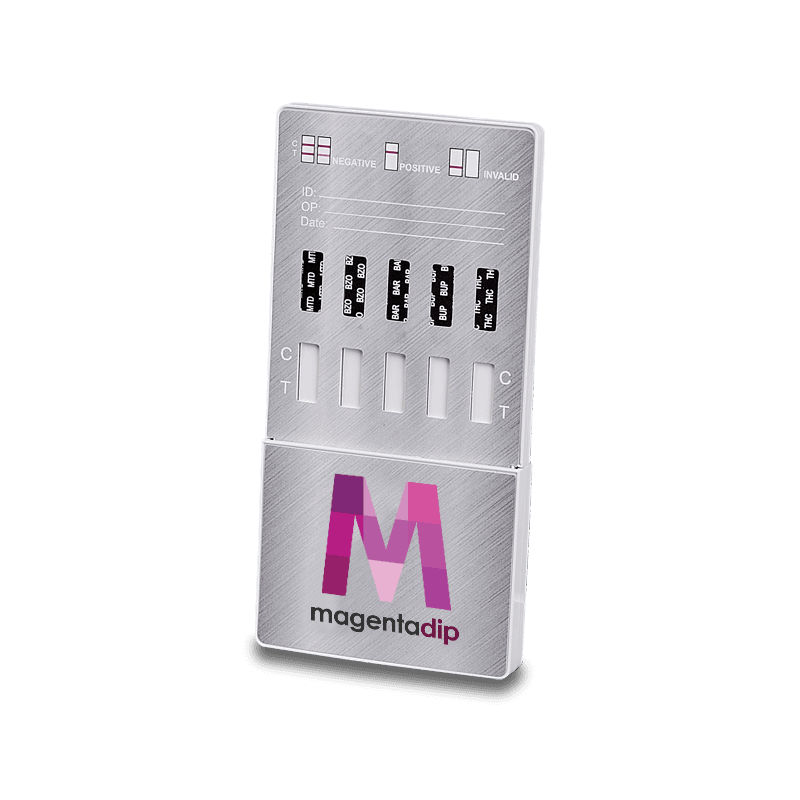
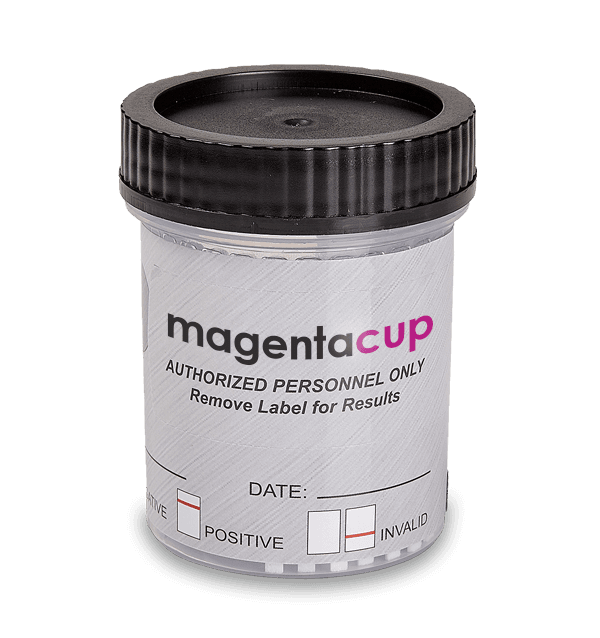
Magenta supplies recovery residences with affordable wholesale pricing on the cups residences actually need, with account structures designed for recovery-housing budgets. Our 10-panel CLIA-waived dip card is the most cost-effective workhorse for routine resident abstinence monitoring — it covers the SAMHSA-5 plus benzodiazepines, methadone, oxycodone, MDMA, and barbiturates at a per-cup cost that's meaningful at the residence's typical 100-500 cup annual volume. Residences testing for fentanyl awareness move to the 13-panel cup that adds fentanyl on the same SKU. The 5-panel CLIA-waived dip card is the most basic option for residences with the tightest budgets, covering the historic SAMHSA-5 substances.
For fentanyl-aware residences, we also stock fentanyl single-strip and xylazine single-strip harm-reduction tests. These are not CLIA-waived for clinical decision-making in most jurisdictions but are useful for harm-reduction conversations with residents — particularly residents who have re-entered the community after time away and may not be aware of how dramatically the fentanyl supply has changed.
On the operations side, we make wholesale access easy for small residences. There is no minimum order to open a wholesale account — the first wholesale tier kicks in at 100 units of a SKU, which most residences hit on their first order. NET 30 terms are available on approved accounts. Recurring monthly subscriptions auto-deliver at the residence's historical volume with an additional 5-10% off — for a residence operator running multiple houses, subscriptions eliminate the reorder burden entirely.
For residence networks operating multiple houses under a single ownership or umbrella organization (regional sober-living operators, recovery-housing nonprofits, statewide Oxford House chapters), our sub-account billing supports per-house consumption tracking and shipping while consolidating the invoice to the central operator. Wholesale tier is set against combined network volume — meaningfully better than running each house as a separate small account.
Recommended Products for Sober Living
The panels and form factors sober living order most.
Compliance Considerations for Recovery Residences
Sober living and recovery residences operate in a regulatory landscape that varies dramatically by state. Some states have formal recovery-residence licensure or certification programs (Florida via the Florida Association of Recovery Residences, Pennsylvania via DDAP, others), while many states have no specific licensing for sober living or recovery residences distinct from general rental housing. The National Alliance for Recovery Residences (NARR) maintains a four-level voluntary standards framework adopted by many state recovery-residence associations as the basis for state certification programs.
Drug testing in a recovery residence is typically a contractual condition of residence — the resident agreement specifies the testing program (frequency, panels, observed vs unobserved collection, consequences of positive results) and the resident signs as a condition of admission. Because the residence is generally not a healthcare provider, the testing operates as a contractual abstinence-verification program rather than as clinical drug monitoring. Residences that integrate clinical services may also operate under HIPAA and 42 CFR Part 2 confidentiality requirements; pure-recovery-residence operations generally do not.
Federal Fair Housing Act protections apply to recovery residences as a category — recovery from substance use disorder qualifies as a protected disability, and zoning or local ordinances that single out sober living houses for restriction beyond what applies to other group housing generally violate the FHA. The U.S. Department of Justice and Department of Housing and Urban Development have issued joint guidance on this. Residences should be aware that they cannot use a positive drug test as the sole basis for immediate eviction in a manner inconsistent with state landlord-tenant law and FHA reasonable-accommodation requirements; the residence agreement should specify the procedure (which may include a defined response sequence: warning, increased testing, treatment referral, eventual discharge from the residence).
For recovery residences that contract with state Medicaid recovery-support service programs, certified community behavioral health clinics, or veterans-recovery-housing programs, additional contract-specific testing requirements may apply. Residences receiving any federal-program funding (HHS, SAMHSA, VA, HUD) should be aware that their testing program may be subject to specific contractual requirements from the funder, including documentation, panel composition, and response-to-positive-result procedures.
Key regulations and standards
- State recovery-residence licensure / certification — Varies by state — some states have formal certification (FL, PA, others), many do not.
- NARR standards — National Alliance for Recovery Residences voluntary four-level framework adopted by many state associations.
- Fair Housing Act — Recovery from SUD is a protected disability — residence policies must comply with FHA reasonable-accommodation requirements.
- State landlord-tenant law — Eviction procedures, including for positive drug-test results, must comply with state-specific tenant protections.
- 42 CFR Part 2 (when applicable) — Applies if the residence is part of an integrated clinical-program operation; does not generally apply to pure-residence operations.
- Federal-program funding requirements — SAMHSA / VA / HUD-funded residences may face funder-specific testing-program requirements.
Recovery-residence regulation varies dramatically by state and integrates with multiple federal protections. This information is for general guidance only — consult qualified counsel familiar with your state's recovery-residence law and federal Fair Housing Act application.
"Recovery residence operators consistently tell us the same thing: they were buying cups at retail from a big-box online retailer because that's what came up in a search. Switching to wholesale pricing sized for the residence's actual annual volume — even a 12-bed house ordering monthly qualifies — cuts per-cup cost meaningfully. For network operators running multiple houses, sub-account billing with a wholesale tier set against combined network volume is dramatically better than each house running its own small account."
Frequently Asked Questions
Is there a minimum order for sober living houses?+
No minimum to open a wholesale account. The first wholesale tier kicks in at 100 units of a SKU, which most residences hit on their first monthly order. A 12-bed house testing each resident weekly is using ~50 cups a month — well above the first wholesale tier on a single-month order.
What panel should a recovery residence use?+
Most residences standardize on a 10-panel CLIA-waived dip card as the workhorse — it covers the standard SAMHSA-5 plus benzodiazepines, methadone, oxycodone, MDMA, and barbiturates at the most affordable per-cup cost. Residences serious about fentanyl awareness move to the 13-panel cup that adds fentanyl on the same SKU. The 5-panel is the most basic option for residences with the tightest budgets.
Should we be testing for fentanyl?+
For most residences, yes. Fentanyl-driven overdose mortality is now the leading cause of death for many residents who relapse. Fentanyl does not cross-react with the standard opiate immunoassay, so a panel without dedicated fentanyl screening will miss most fentanyl exposure. Our 13-panel cup adds fentanyl on the same SKU as the standard panel. Many residences also stock fentanyl single-strip tests for harm-reduction conversations with residents.
Can we use these for observed collection?+
Yes — our cups support both observed and unobserved collection. Most residences use unobserved collection as the default with specific criteria (after an aberrant result, for residents in their first 30 days, when there is reason to believe the resident may attempt to alter the specimen) for moving to observed collection. Built-in specimen-validity testing (creatinine, pH, oxidants) on our 12- and 14-panel cups provides a check on unobserved collections.
Can we run multiple sober living houses on one account?+
Yes — and we recommend it for network operators. Our wholesale account structure supports sub-account consumption tracking so each house gets its own ship-to address and consumption record, while a single invoice consolidates to the central operator. Wholesale tier is set against combined network volume, typically dramatically better than running each house as a separate small account.
How do we handle a resident who tests positive?+
That's a residence-policy decision rather than a supply question, but the typical NARR-aligned framework involves a defined response sequence specified in the residence agreement — initial conversation, increased testing frequency, treatment-engagement referral, and eventual discharge from the residence if abstinence cannot be re-established. The residence agreement should specify the procedure clearly, and the response should align with state landlord-tenant law and FHA reasonable-accommodation requirements. Single-incident immediate-eviction policies can be legally exposed.
Do you offer recurring subscription orders?+
Yes — once your wholesale account is approved, you can set up a recurring monthly order at the residence's historical volume with an additional 5-10% off our wholesale pricing. For house managers and residence operators, monthly subscriptions eliminate the reorder cycle entirely. You can pause, skip, or change quantities from the account dashboard.
Do we need to be a healthcare provider to run these tests?+
No. Recovery residences run drug testing as a contractual abstinence-verification program under the resident agreement, not as clinical drug monitoring. You do not need a CLIA Certificate of Waiver to run these cups for abstinence-verification purposes in a recovery-residence setting (CLIA applies to testing performed for clinical decision-making by or on behalf of a healthcare provider). Residences that are part of an integrated clinical program should consult their clinical program's compliance team on CLIA applicability.
Ready to Cut Your Cup Cost?
Wholesale pricing with no minimum order, network-friendly sub-account billing, and fentanyl-inclusive panels designed for current overdose mortality realities.
Related Industries
Rehab Centers
High-volume monitoring with chain-of-custody options for residential and outpatient treatment programs.
Explore →Methadone Clinics
SAMHSA-compliant 8-times-per-year random testing supplies for opioid treatment programs.
Explore →Probation & Court-Mandated
Chain-of-custody-ready testing supplies for probation, drug courts, and supervised release programs.
Explore →Pain Clinics
Compliance-grade urine drug monitoring for opioid management, prescription adherence, and patient safety.
Explore →