
Drug Testing for Probation & Court-Mandated Supervision
Chain-of-custody-ready cups and dip cards for probation departments, drug courts, parole, and pretrial supervision — sized for caseload volumes and built for the documentation a court will actually accept.


The Probation & Drug Court Testing Challenge
Probation officers, drug-court coordinators, and pretrial-services agencies run testing programs where every result is one motion-to-revoke away from court. A probationer with a 30-month supervision term may be testing 2 to 4 times a week for the first 6 months and weekly thereafter. A drug-court participant may test 3 to 5 times a week during the most intensive phase. A single field officer with a 60-person caseload is collecting and documenting hundreds of specimens per month, and every one of them needs to hold up if the case goes back in front of the judge.
The supply problem is the combination of volume and documentation. Most agencies buy from a single vendor for instant cups and a second for chain-of-custody forms — sometimes a third for ETG alcohol strips when the supervision plan includes an alcohol-abstinence condition. The cups have to be reliable enough that a positive result actually triggers the supervised individual's defense response — denial, dilution claims, prescription-substitution claims — and the documentation has to be tight enough that the response doesn't succeed. A weak chain of custody, missing collector signature, or unclear photo of a faint line gives the defense attorney exactly the argument they need.
Probation populations also need testing panels designed for what people are actually using locally. Fentanyl-driven overdose mortality is now the leading cause of death for many supervised populations, and a standard opiate panel without dedicated fentanyl screening will miss most opioid use. Synthetic cannabinoids (K2/Spice), kratom, and gabapentin appear regularly in probation caseloads but aren't on standard panels. Agencies that haven't updated panel composition in five years are testing for the wrong substances on the wrong people.
How Magenta Helps Probation Departments and Drug Courts
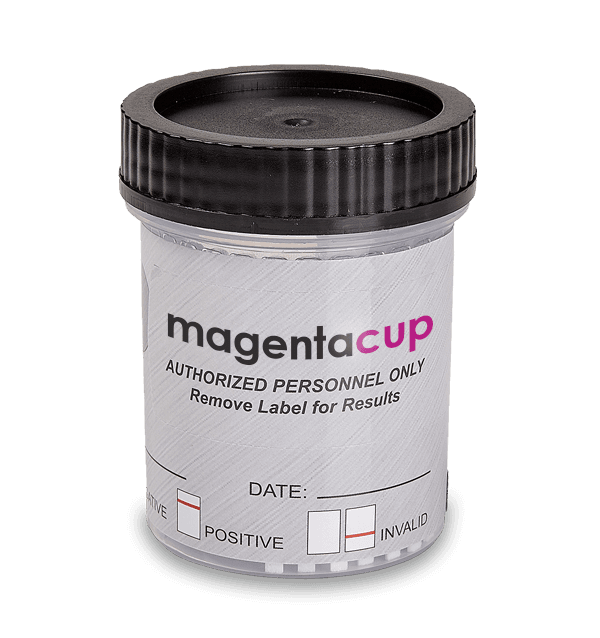
Magenta supplies probation departments, drug courts, and pretrial-services agencies with cups designed for the actual job: defensible point-of-collection screening with the panel composition the local caseload needs. Our 13-panel cup with fentanyl is the most common workhorse for agencies that have updated panels for current drug trends; it covers the SAMHSA-5 plus benzodiazepines, methadone, oxycodone, buprenorphine, MDMA, barbiturates, and dedicated fentanyl. Agencies needing specimen-validity testing on the same cup use the 14-panel with fentanyl and adulterants. For drug-court programs with alcohol-abstinence conditions, ETG alcohol dip cards run alongside the standard cup; for fentanyl-aware harm-reduction programs, fentanyl and xylazine single-strip tests support both supervision and overdose-prevention conversations.
We supply chain-of-custody forms aligned to court-friendly formats acceptable to the supervising court for any result that will go to a reference lab for confirmation. Most probation departments use the instant cup result for routine supervision and lab-confirm specific results that will be the basis for a revocation motion — the standard model is presumptive screening in the field, confirmation when stakes warrant it. We can supply both the screening kits and the COC forms / lab pickup logistics on one wholesale account.
Operationally, our wholesale tiered pricing reflects probation-caseload volumes — a department running 4,000 tests per month is at a meaningfully different price than one running 400. NET 30 terms on approved governmental accounts are standard, and we work with municipal and county purchasing departments on the documentation their procurement processes require (W-9, COI, NET 30 application). Same-day shipping on orders placed before 3pm ET means a department that runs out mid-week has resolution next business day. Recurring monthly subscriptions auto-deliver at historical volume with an additional 5-10% off — once department administrators see consumption stabilize, most move to subscription and stop thinking about reorders.
For multi-county drug courts, statewide pretrial agencies, or judicial-district consortia that consolidate purchasing, we support sub-account billing so individual offices or counties get their own shipping and consumption tracking while a single invoice rolls up to the consolidated purchaser. This is the same infrastructure we use for transportation TPAs, and it solves the same organizational problem.
Recommended Products for Probation
The panels and form factors probation & court-mandated order most.
Compliance Considerations for Court-Ordered Testing
Probation and court-mandated drug testing operates under the authority of the supervising court's order, which sets the conditions of supervision under state criminal-procedure law or, for federal supervisees, 18 USC 3563 (probation) or 18 USC 3583 (supervised release). The testing program needs to be authorized by the order, conducted by personnel with authority to act on behalf of the supervising agency, and documented in a manner that supports both routine supervision decisions and any subsequent revocation proceeding.
Chain of custody is the central evidentiary concept for court-ordered testing. A well-maintained chain documents the specimen from the moment of collection through every handler, storage location, and analytical step, with each transfer signed and dated. A break in the chain — an unsigned form, an unaccounted-for hour between collection and lab pickup, a temperature reading not documented — gives the defense attorney an argument that the specimen tested was not the specimen collected. Instant-cup results used in supervision decisions are typically not subject to the same forensic standard as confirmation testing, but any positive result that will become the basis for a revocation motion should be lab-confirmed by GC-MS or LC-MS-MS with a documented forensic chain of custody acceptable to the supervising court.
Specimen-validity testing matters in court-ordered testing specifically because the supervised population has both motivation and opportunity to alter specimens. Built-in creatinine, pH, and oxidant testing on the cup flags abnormal specimens at the point of collection rather than after the fact. Observed collection is increasingly standard practice in many drug courts and high-supervision caseloads — agencies should document whether each collection was observed in the chain-of-custody form and align observation policy with the supervising court's expectations.
Confidentiality treatment varies by jurisdiction. Probation supervision records, including drug-test results, are generally accessible to the court, the prosecution, the defense, and (where applicable) treatment providers under 42 CFR Part 2 consent. Some jurisdictions treat results as confidential supervision records not subject to public records requests; others permit broader disclosure. Drug-court programs that use a treatment-court model integrating clinical treatment with judicial supervision often operate under 42 CFR Part 2 consent that explicitly authorizes information-sharing among the drug-court team.
Key regulations and standards
- State criminal procedure / 18 USC 3563, 3583 — Statutory authority for probation and supervised release conditions, including drug testing.
- Federal Rules of Criminal Procedure 32.1 — Procedural requirements for revocation of probation or supervised release — drug-test evidence subject to standard evidentiary rules.
- Forensic chain of custody — Specimens used in court must be supported by documented chain of custody from collection through final analysis — using a forensic COC form acceptable to the supervising court.
- 42 CFR Part 2 — Federal SUD treatment confidentiality — applies when probation testing is integrated with treatment court / drug court clinical providers.
- State medical board / lab licensure — Reference laboratories used for confirmation must be appropriately licensed and accredited (HHS, CAP, state).
Court-ordered testing requirements vary by jurisdiction, supervising court, and specific terms of the order. This information is for general guidance only — consult agency counsel and the supervising court for specific procedural requirements applicable to your program.
"Probation departments and drug courts consistently tell us the same thing: the cup itself isn't the differentiator, the operational fit is. Wholesale pricing structured for caseload volume, governmental NET 30 terms that match the way the agency actually procures, sub-account billing for multi-county consortia, fentanyl on the cup so the panel matches what the supervised population is actually using — those are the things that move the operational needle, not a marginal per-test price difference."
Frequently Asked Questions
Are your kits acceptable for court-ordered testing?+
Yes. Our cups are FDA-cleared and CLIA-waived, and we supply chain-of-custody forms suitable for documenting specimen handling in a supervision program. For any result that will be used to support a revocation motion, the standard practice is to lab-confirm the instant-cup positive by GC-MS or LC-MS-MS with documented forensic chain of custody — we supply forensic COC forms acceptable to the supervising court and partner with accredited labs for confirmation. Talk to your supervising court about specific evidentiary requirements they expect.
What panel makes sense for current probation caseloads?+
For most jurisdictions, a 13-panel with fentanyl is the modern baseline — it covers the SAMHSA-5, benzodiazepines, methadone, oxycodone, buprenorphine, MDMA, barbiturates, and fentanyl on one cup. Agencies in regions with significant K2/Spice or kratom use can run dedicated single-strip tests alongside the standard cup. For drug courts with alcohol-abstinence conditions, ETG alcohol dip cards detect alcohol use up to ~80 hours after consumption — a longer window than breath or blood alcohol testing.
Do you supply chain-of-custody forms?+
Yes — we supply forensic COC forms suitable for routine supervision-program collections and for specimens going to reference-lab confirmation. We work with each program to provide the COC format the supervising court expects; some courts have specific preferred forms, others accept any documented forensic chain of custody.
Do you offer government purchasing terms?+
Yes. NET 30 invoicing is standard on approved governmental accounts. We provide W-9, certificate of insurance, and any other documentation your county or municipal procurement office requires for vendor onboarding. We work with state cooperative purchasing programs where applicable.
Can you support multi-county drug courts or judicial-district consortia?+
Yes. Our wholesale account structure supports sub-account billing — individual courts or county probation offices get their own shipping addresses and consumption tracking, while a single invoice consolidates to the central purchaser. Wholesale tier is set against total consortium volume rather than per-county volume, which makes the pricing meaningfully better for consortia.
What about ETG alcohol testing?+
We stock ETG (ethyl glucuronide) alcohol dip cards and our 80-hour ETG combined alcohol dip card. ETG is a metabolite that remains detectable in urine for roughly 72 to 80 hours after alcohol consumption — substantially longer than breath or blood testing. Most drug courts with alcohol-abstinence conditions run ETG alongside the standard drug cup at every supervision visit.
How fast can you ship?+
Same-day shipping on orders placed before 3pm ET on any in-stock SKU. Most probation and drug-court departments are next-business-day delivery to ground addresses. For emergency situations — a high-supervision caseload that runs out mid-week — overnight options are available at standard carrier rates.
What's the minimum order quantity?+
There is no minimum to open a wholesale account. Tiered pricing kicks in at 100 units of a SKU and scales meaningfully at 500 and 1,000+. A typical mid-sized probation department running 2,000+ tests per month qualifies for the second or third tier on first order.
Ready to Modernize Your Testing Program?
Wholesale pricing, governmental NET 30 terms, sub-account billing for multi-county consortia, and panels designed for current drug trends — including fentanyl on the cup.
Related Industries
Law Enforcement
Pre-employment, fitness-for-duty, and intake testing supplies for police, sheriff, and corrections agencies.
Explore →Rehab Centers
High-volume monitoring with chain-of-custody options for residential and outpatient treatment programs.
Explore →Sober Living
Affordable abstinence-monitoring tests for sober living houses and recovery residences.
Explore →Government & Military
Federal Drug-Free Workplace Program supplies for government agencies, contractors, and military commands.
Explore →