
Drug Testing for Federal & Military Programs
Federal Drug-Free Workplace Program supplies for federal civilian agencies, military commands, and federal contractors — built for HHS Mandatory Guidelines compliance, GSA-compatible procurement, and the documentation federal programs actually require.
The Federal & Military Testing Challenge
Federal civilian drug testing operates under Executive Order 12564 and the SAMHSA Mandatory Guidelines for Federal Workplace Drug Testing Programs — currently published as the Urine Mandatory Guidelines (most recent revisions effective 2024) and the Oral Fluid Mandatory Guidelines. Every federal agency with a drug-free workplace program operates under these guidelines, which prescribe panel composition (the SAMHSA-5 plus optional analytes), cutoff concentrations, collection procedures, specimen handling, chain of custody requirements via the Federal Drug Testing Custody and Control Form, HHS-certified laboratory confirmation, and MRO review. The guidelines are prescriptive and the documentation requirements are extensive.
Military drug testing operates under DoD Directive 1010.1 and service-specific instructions (Army Regulation 600-85, OPNAVINST 5350.4 for Navy, AFI 44-121 for Air Force, MCO 5300.17 for Marines). Military testing volumes are large — DoD conducts more than two million tests annually across services — and the testing is conducted by trained Unit Prevention Leaders (UPLs) at the command level using standardized collection procedures. The actual testing happens at DoD Forensic Toxicology Drug Testing Laboratories, but commands need the collection supplies (cups, COC forms, urine collection accessories).
Federal contractors subject to the Drug-Free Workplace Act of 1988 — generally contractors with federal contracts over $100,000 or grants of any amount — operate under their own drug-free workplace policies that meet the DFWA requirements but are not directly subject to the HHS Mandatory Guidelines unless the contract specifies it. DOT-regulated federal contractors (e.g., contractors providing safety-sensitive transportation services to a federal agency) are subject to 49 CFR Part 40 in addition. The procurement reality for federal contractors is that GSA Schedules, SEWP, NASPO, and other federal-cooperative-purchasing structures govern how the contractor procures testing supplies.
How Magenta Helps Government & Military Programs
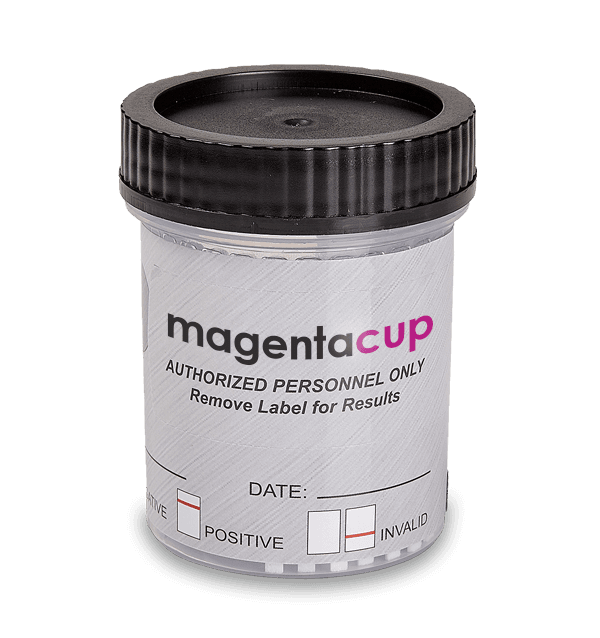
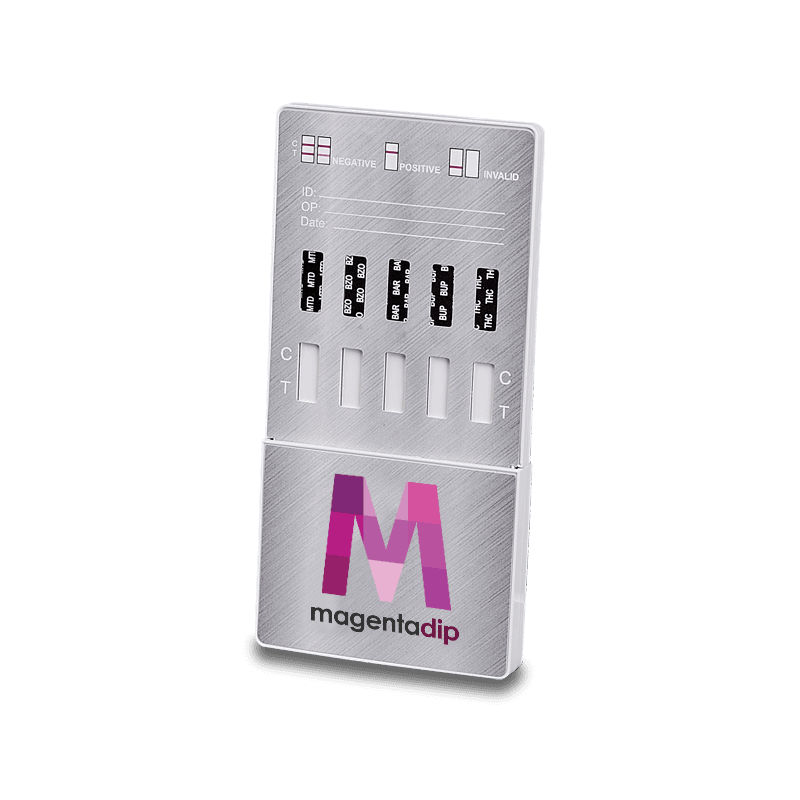
Magenta supplies federal-program-compatible testing kits to federal civilian agencies, military commands, and federal contractors. Our 5-panel CLIA-waived urine cups and dip cards meet the panel composition specified in the SAMHSA Urine Mandatory Guidelines (marijuana, cocaine, amphetamines, opiates, phencyclidine). Federal agencies have authority under the 2024 Mandatory Guideline revisions to expand panels with optional analytes — programs choosing to test for benzodiazepines, methadone, oxycodone, or other analytes can use our 10-, 12-, 13-, or 14-panel cups. We supply SAMHSA Federal CCFs (the prescribed chain-of-custody form for federal civilian testing) and connect to HHS-certified laboratories for confirmation under the prescribed procedures.
For federal contractors subject to the Drug-Free Workplace Act but operating under their own contractor-policy framework rather than HHS Mandatory Guidelines, our standard workplace-testing supply lineup applies. Many federal contractors with safety-sensitive positions use 10-panel or 12-panel cups for pre-employment, random, and post-incident testing — matching what they would use as any other workplace employer, with documentation appropriate to demonstrate DFWA compliance.
For military command-level collection programs, our standard collection cups and dip cards support UPL-conducted collection that ships to DoD Forensic Toxicology Drug Testing Laboratories for confirmation. Commands typically standardize on a single collection cup and run their command-level testing program with locally-procured cups and the chain-of-custody documentation prescribed by service instruction. Magenta supplies cups appropriate for command-level collection volumes and works with service contracting structures where applicable.
Operationally, we work with federal procurement structures. We support GSA-schedule pricing where applicable, NASPO and state-cooperative-purchasing arrangements for state/local government entities running federal-aligned programs, and direct wholesale purchasing for agencies and contractors with their own procurement. NET 30 invoicing is standard on approved governmental and federal-contractor accounts. We provide W-9, SAM registration documentation, certificate of insurance, and any other documentation federal procurement offices require for vendor onboarding.
Recommended Products for Government
The panels and form factors government & military order most.
Compliance Considerations for Federal & Military Testing
Federal civilian drug testing under Executive Order 12564 is the most prescriptive workplace-testing framework in U.S. law. The HHS Mandatory Guidelines for Federal Workplace Drug Testing Programs (Urine Guidelines and Oral Fluid Guidelines, both most recently revised in 2024) prescribe every operational element: panel composition, initial-test and confirmation cutoff concentrations, collection-site requirements, observed-collection criteria, specimen-handling and chain-of-custody requirements via the Federal CCF, HHS-certified laboratory analysis by NLCP-certified labs, MRO review by qualified Medical Review Officers, and split-specimen testing rights. Federal civilian agencies must use HHS-certified labs published in the SAMHSA NLCP list.
Military drug testing under DoD Directive 1010.1 operates on a parallel but distinct framework. DoD has its own forensic-laboratory network (DoD Forensic Toxicology Drug Testing Laboratories at Tripler, Norfolk, Jacksonville, and Fort Meade) and service-specific testing instructions. Military service members are subject to UCMJ enforcement on positive results, and the service-instruction procedural framework is the equivalent of the chain-of-custody and confirmation framework for the federal civilian program. The DoD program traditionally tested on a panel that has evolved over time (THC, cocaine, amphetamines, opiates, plus various synthetic-opioid and designer-drug additions over time); the current panel composition is set by DoD policy and updates periodically.
Federal contractors operate under the Drug-Free Workplace Act of 1988 — a contractor-policy requirement rather than a direct testing-program prescription. DFWA requires contractors to publish a drug-free workplace policy, notify employees, establish a drug-free awareness program, and require employees to notify the employer of any criminal drug conviction. DFWA does not directly require workplace drug testing. Many federal contractors implement workplace testing as part of their DFWA compliance program; the testing program design is generally the contractor's choice and is typically modeled on industry-standard workplace testing rather than directly on the HHS Mandatory Guidelines. Contractors providing safety-sensitive transportation services subject to DOT are separately subject to 49 CFR Part 40.
Federal procurement compliance adds another layer. Federal civilian agencies and prime contractors typically procure testing supplies through GSA Schedules (Federal Supply Schedule), NASPO ValuePoint cooperative agreements, NIH NITAAC contracts, or other federal-cooperative-purchasing structures. Vendor onboarding for federal procurement typically requires SAM (System for Award Management) registration, CAGE code, current W-9, and varying levels of cybersecurity certification (DFARS for DoD contractors). Small Business and HUBZone designations affect competitive procurement opportunities. State and local government entities running federally-funded programs (e.g., HHS-funded substance-use treatment programs) may face additional cost-principle requirements under 2 CFR Part 200 Uniform Guidance.
Key regulations and standards
- Executive Order 12564 — Establishes the federal civilian Drug-Free Workplace Program — implemented through HHS Mandatory Guidelines.
- HHS Mandatory Guidelines (Urine and Oral Fluid) — SAMHSA-published prescriptive procedures for federal civilian testing — panels, cutoffs, collection, chain of custody, lab certification, MRO.
- DoD Directive 1010.1 and service instructions — Military drug testing framework — AR 600-85, OPNAVINST 5350.4, AFI 44-121, MCO 5300.17.
- Drug-Free Workplace Act of 1988 — Federal contractor drug-free workplace policy requirement — not a direct testing prescription but commonly implemented through workplace testing programs.
- 49 CFR Part 40 (when applicable) — DOT testing requirements apply to federal contractors providing safety-sensitive transportation services in addition to other federal frameworks.
- Federal procurement (FAR, DFARS, GSA, SAM) — Federal acquisition framework — vendor onboarding, contract vehicles, and small-business designations affect testing-supply procurement.
Federal and military testing requirements are highly prescriptive and subject to ongoing rulemaking. This information is for general guidance only — federal civilian programs should consult agency drug-program coordinators and HHS Mandatory Guidelines; military commands should consult service-specific testing instructions; federal contractors should consult contract-specific requirements and DFWA counsel.
"Federal and military buyers consistently tell us the same thing: the procurement complexity is the bottleneck, not the cup chemistry. Vendors that can support GSA-compatible pricing, SAM registration documentation, governmental NET 30 terms, and the Federal CCF chain for HHS-certified lab confirmation are dramatically easier to onboard than vendors that treat federal procurement as an afterthought. Volume pricing set against total agency or command volume — rather than per-office volume — is what makes the unit economics work."
Frequently Asked Questions
Are your cups compatible with HHS Mandatory Guidelines testing?+
Our 5-panel urine cups meet the panel composition specified in the SAMHSA Urine Mandatory Guidelines (marijuana, cocaine, amphetamines, opiates, phencyclidine). Federal civilian testing under the Mandatory Guidelines requires Federal CCF chain of custody and HHS-certified laboratory confirmation by NLCP-certified labs — we supply Federal CCFs and connect to HHS-certified labs for the confirmation chain. The instant-cup result at collection is informational; the binding federal civilian test result is the HHS-certified lab confirmation with MRO review.
Can federal contractors use these for DFWA compliance?+
Yes. Federal contractors subject to the Drug-Free Workplace Act of 1988 typically implement workplace drug testing as part of DFWA compliance. The testing program design is generally the contractor's choice — many use 10-panel or 12-panel cups appropriate for the contractor's workforce composition, with internal chain of custody and (where the contract requires it) reference-lab confirmation. Contractors providing safety-sensitive transportation services subject to DOT must additionally comply with 49 CFR Part 40.
Do you support GSA Schedule pricing?+
We work with federal procurement structures and can support GSA-compatible pricing arrangements where your agency procures through the Federal Supply Schedule. For agencies or contractors not procuring through GSA, our standard wholesale pricing is structured to align competitively with federal-supply alternatives. Talk to our team about your specific procurement vehicle.
Are you registered in SAM?+
Talk to our team about your specific procurement vehicle and the documentation requirements your federal-procurement office expects. We provide W-9, CAGE code, certificate of insurance, and other vendor-onboarding documentation as needed. For programs operating under DFARS or NIST SP 800-171 cybersecurity requirements, we can discuss requirements during onboarding.
Can military commands use these for command-level testing?+
Command-level testing programs operating under service-specific instructions (AR 600-85, OPNAVINST 5350.4, AFI 44-121, MCO 5300.17) typically use locally-procured cups for UPL-conducted collection, with specimens shipped to DoD Forensic Toxicology Drug Testing Laboratories for confirmation. Our standard collection cups support this workflow. Specific panel composition and procedural requirements should follow the applicable service instruction and command policy.
What about cost-principle compliance for federally-funded programs?+
State, local, and tribal entities running programs funded by federal grants are subject to 2 CFR Part 200 Uniform Guidance, including cost-principle requirements on allowable, allocable, and reasonable costs. Drug testing supplies for federally-funded programs are typically allowable costs when documented appropriately. Talk to your program's compliance team for specifics on your funding source.
Do you supply Federal Drug Testing Custody and Control Forms?+
Yes — we supply SAMHSA Federal CCFs (the prescribed chain-of-custody form for federal civilian testing under the HHS Mandatory Guidelines) as part of our standard supply offering. For tests that will be confirmed at HHS-certified laboratories, the Federal CCF is the prescribed chain document and is required for the result to be reported as a federal civilian testing result under the Mandatory Guidelines.
What's the minimum order quantity?+
There is no minimum to open a wholesale account. Tiered pricing kicks in at 100 units of a SKU and scales meaningfully at 500 and 1,000+. Federal program orders typically qualify for the second or third wholesale tier on first order — even small agency or command programs typically order in 500+ unit increments.
Ready to Procure Federal-Compatible Testing Supply?
HHS Mandatory Guidelines-compatible panels, Federal CCF chain documentation, governmental NET 30 terms, and pricing structures compatible with federal procurement vehicles.
Related Industries
DOT Transportation
49 CFR Part 40-compliant testing supplies for commercial drivers and safety-sensitive roles.
Explore →Law Enforcement
Pre-employment, fitness-for-duty, and intake testing supplies for police, sheriff, and corrections agencies.
Explore →Workplace HR
Pre-employment, random, and post-incident testing supplies for businesses of any size.
Explore →Staffing Agencies
High-volume pre-employment screening supplies for staffing firms placing contingent and temp workers.
Explore →