
DOT-Compliant Drug Testing for Transportation
5-panel cups, dip cards, and lab-confirmation kits built around 49 CFR Part 40. Bulk pricing for carriers, owner-operators, and third-party administrators.


The DOT Drug Testing Challenge
DOT testing is one of the most prescriptive testing programs in the country. 49 CFR Part 40 specifies the exact 5-drug panel, the cutoff concentrations, the chain-of-custody form, the role of the collector, the role of the Medical Review Officer, the role of the Substance Abuse Professional, what split-specimen rights the driver has, and how every result must be reported. Every step is auditable. FMCSA, FAA, FRA, FTA, and PHMSA enforce slightly different program-specific overlays on top.
For motor carriers, the most expensive part of the program is usually random testing. A carrier with 100 CDL drivers is required to test at a 50% annual rate for drugs (the FMCSA rate as of the most recent rulemaking) — that is roughly 50 random drug tests per year, plus any post-accident, reasonable-suspicion, return-to-duty, and follow-up testing. Pre-employment testing is required before any new driver performs a safety-sensitive function. The supply spend adds up, and a single missed pre-employment test can leave a truck parked and a load undelivered.
What goes wrong in practice is usually procedural, not chemical. Wrong form (a non-Federal CCF), wrong collector (someone who has not completed DOT collector training), unobserved collection when an observed collection was required, a chain-of-custody seal that is broken or not initialed, a positive that the carrier acts on before the MRO has spoken with the driver. Each of these can invalidate a result and expose the carrier in an audit or in litigation after a crash.
How Magenta Helps DOT-Regulated Carriers
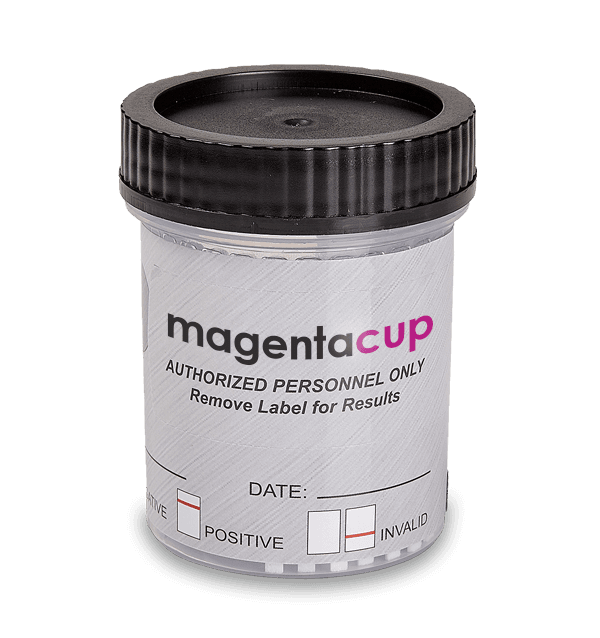
Magenta supplies DOT-regulated motor carriers, third-party administrators (TPAs), and consortium operators with the testing kits, custody-and-control forms, and lab-confirmation accounts needed to run a 49 CFR Part 40 program end-to-end. Our 5-panel CLIA-waived cup screens for amphetamines, cocaine, opiates, phencyclidine, and THC at the cutoffs specified for DOT testing, and our 12-panel cups are available for the non-DOT testing many carriers do alongside (state workers' comp, company-policy testing, fitness-for-duty).
The piece most carriers under-invest in is the chain-of-custody form. Under 49 CFR Part 40.45, DOT-regulated specimens must be collected on the Federal Drug Testing Custody and Control Form (CCF) — the five-part form recognized by HHS and the DOT operating administrations. Using any other form for a DOT-regulated collection invalidates the test. We stock current-revision Federal CCFs in single-pack and case quantities and ship them as a separate line item or bundled with cups for collection sites.
Instant point-of-collection results are useful for the carrier's internal operations — knowing in 5 minutes whether to send a driver out on a load or hold them pending lab confirmation — but DOT requires every regulated test to be sent to a HHS-certified laboratory for confirmation, with results reviewed by a qualified Medical Review Officer (MRO) before they can be reported as positive. Magenta partners with HHS-certified labs and credentialed MROs through our reference-lab program so carriers without an existing lab relationship can stand one up alongside their kit order. Carriers who already have a lab and MRO relationship can buy kits-only at the same wholesale pricing.
For TPAs and consortium operators managing testing for multiple small carriers, our wholesale account structure supports sub-account billing and shipping addresses so kits can drop-ship to individual carrier sites while a single invoice rolls up to the TPA. NET 30 terms are standard for approved accounts. Same-day shipping on in-stock kits means a carrier who calls Wednesday morning needing 10 cups for a roadside-suspicion situation has them Thursday.
Recommended Products for DOT
The panels and form factors dot transportation order most.
Compliance Considerations for DOT-Regulated Carriers
49 CFR Part 40 is the master regulation for all DOT drug and alcohol testing. It defines the 5-drug panel (marijuana, cocaine, opiates including codeine, morphine, 6-AM, hydrocodone, hydromorphone, oxycodone, and oxymorphone after the 2018 rule, plus phencyclidine and amphetamines including MDMA), the screening and confirmation cutoffs, the collection procedure (including when observed collections are required — typically only when there is reason to believe the donor may attempt to alter or substitute the specimen, after a verified positive in the last 6 months, or on return-to-duty and follow-up testing), the chain-of-custody process, and the role of the MRO.
FMCSA's overlay (49 CFR Part 382) governs commercial motor vehicle operations. It requires pre-employment, random, post-accident (under specific circumstances), reasonable-suspicion, return-to-duty, and follow-up testing for any driver operating a commercial motor vehicle requiring a CDL. The random testing rate is set annually by the FMCSA Administrator — historically 50% for drugs and 10% for alcohol, with adjustments based on industry positive rates. Every regulated carrier must use the FMCSA Clearinghouse for query and reporting requirements.
Pre-employment testing must be completed and a negative result received before any new driver performs a safety-sensitive function — there are no provisional starts. Post-accident testing is required when the accident involves a human fatality, or when the driver receives a citation and the accident involves bodily injury treated away from the scene or a vehicle requiring tow-away. The window for post-accident testing is 32 hours for drugs (8 hours for alcohol); after 32 hours, the test is not required but the carrier must document why it was not done.
The Substance Abuse Professional (SAP) and the return-to-duty process are governed by 49 CFR Part 40 Subpart O. A driver with a verified positive cannot return to safety-sensitive duties until they have been evaluated by a qualified SAP, completed the SAP-prescribed education or treatment, and passed a return-to-duty test under direct observation. Follow-up testing — minimum 6 tests in the first 12 months, with the schedule set by the SAP — continues for up to 60 months. All of this rolls up into the FMCSA Clearinghouse, which carriers must query before hire and annually for every CDL driver they employ.
Key regulations and standards
- 49 CFR Part 40 — Master DOT testing regulation — panel, cutoffs, collection, chain-of-custody, MRO process.
- 49 CFR Part 382 (FMCSA) — Commercial motor vehicle testing — pre-employment, random, post-accident, return-to-duty.
- FMCSA Clearinghouse — Mandatory query and reporting database for CDL driver drug and alcohol violations.
- Federal CCF — The only chain-of-custody form valid for DOT-regulated specimen collection.
- HHS-certified laboratory + MRO — Required for confirmation of any non-negative DOT screening result.
Information provided for general guidance only. DOT regulations are updated periodically and operating-administration overlays (FMCSA, FAA, FRA, FTA, PHMSA) vary by mode. Consult qualified legal counsel and your DER (Designated Employer Representative) for specific program requirements.
"TPAs and consortium operators consistently tell us the same thing: the operational pain isn't the cup chemistry, it's the logistics. Sub-account shipping with rolled-up invoicing, same-day fulfillment on standard SKUs, and a wholesale tier set against total consortium volume — not per-carrier volume — is the difference between a TPA expanding its book and one losing carriers to a competitor with cleaner ops."
Frequently Asked Questions
Are your tests DOT-compliant?+
Our 5-panel CLIA-waived cups screen at the cutoffs specified for DOT testing under 49 CFR Part 40. However, for any DOT-regulated test, an instant on-site screening result is presumptive only — every non-negative DOT test must be confirmed by an HHS-certified laboratory using GC-MS or LC-MS-MS, with the result reviewed and verified by a qualified Medical Review Officer before it can be reported as a positive DOT result. We supply both the on-site screening kits and access to HHS-certified lab confirmation through our reference-lab partners.
What chain-of-custody form should I use?+
For any DOT-regulated specimen, you must use the current-revision Federal Drug Testing Custody and Control Form (CCF) — the five-part form approved by HHS. Using any other form invalidates the test under 49 CFR Part 40.45. We stock current-revision Federal CCFs in single-pack and case quantities. For non-DOT testing (workers' comp, company-policy testing, fitness-for-duty), a standard 5-part chain-of-custody form is acceptable and ships with most lab-confirmation orders.
Can I do post-accident testing with an instant cup?+
An instant cup can give you a screening result inside the 32-hour DOT window so you have early information about whether to put the driver back in service pending lab confirmation. The DOT result of record, however, must come from an HHS-certified lab and an MRO. Many carriers run an instant screen on-scene or back at the terminal as an operational tool and send the split specimen to the lab in parallel. The on-scene screen is not a substitute for the regulated lab test.
Do you sell to TPAs and consortium operators?+
Yes — TPAs and consortiums are a significant part of our DOT customer base. Our wholesale account structure supports sub-account shipping addresses (so kits drop-ship to each carrier site) with a single rolled-up invoice to the TPA. Pricing reflects total consortium volume, not per-carrier volume, which usually unlocks better tiers than each carrier could get individually.
What's the minimum order to get DOT-compliant pricing?+
There is no minimum to open a wholesale account. Tiered pricing kicks in at 100 units of a SKU and again at 500 and 1,000+. A small carrier with 20 CDL drivers will typically order 30–50 cups per quarter (covering pre-employment, randoms, and reasonable-suspicion); a 100-driver fleet typically orders 150–200 cups per quarter. We can custom-quote any consortium or TPA running 1,000+ cups per quarter.
Does Magenta handle the FMCSA Clearinghouse query and reporting?+
We do not operate as a Clearinghouse query service ourselves, but our TPA partners do. If you need a full-service Clearinghouse-compliant TPA relationship in addition to kits, we can refer you to one of our partner TPAs at no markup. Carriers that already use a TPA for Clearinghouse compliance typically buy kits directly from us and have the TPA handle the regulated paperwork.
Do you supply alcohol testing devices?+
We focus on urine drug testing supplies. For DOT alcohol testing, you need an Evidential Breath Testing (EBT) device on the DOT-approved Conforming Products List, operated by a trained Breath Alcohol Technician (BAT) or a Saliva Alcohol Testing (SAT) device for screening. Most carriers source these from a specialized vendor or have their occupational-health clinic conduct alcohol tests.
How fast does shipping take?+
Orders placed before 3pm ET ship same business day. Standard ground delivery is 1–3 business days for most continental US addresses; 2-day and overnight options are available at checkout. For carriers in time-critical situations (post-accident reasonable suspicion, emergency pre-employment), overnight Saturday delivery is available on request.
Ready to Stock Up?
DOT-compliant kits, Federal CCFs, and lab-confirmation access — built for the carriers, TPAs, and consortiums that actually run the programs.
Related Industries
Workplace HR
Pre-employment, random, and post-incident testing supplies for businesses of any size.
Explore →Staffing Agencies
High-volume pre-employment screening supplies for staffing firms placing contingent and temp workers.
Explore →Law Enforcement
Pre-employment, fitness-for-duty, and intake testing supplies for police, sheriff, and corrections agencies.
Explore →Government & Military
Federal Drug-Free Workplace Program supplies for government agencies, contractors, and military commands.
Explore →