
Drug Testing for Schools, Colleges & Universities
Student-athlete, voluntary, and reasonable-suspicion testing kits for K-12 schools, colleges, and universities — sized for athletic-department and student-health budgets and built for the documentation a school district or campus actually needs.


The School & University Testing Challenge
Educational drug testing programs operate in three distinct contexts. K-12 student-athlete and extracurricular-participant testing — generally permissible under the Supreme Court's Vernonia and Earls decisions for students choosing to participate in school athletics or extracurriculars — is the most common K-12 use case. Voluntary K-12 student drug testing, often funded by parent-association budgets, allows parents to opt in to random testing of their child. Reasonable-suspicion testing at K-12 has stricter constitutional limits and is heavily fact-specific. At the college level, NCAA-affiliated athletic departments run drug testing under NCAA Bylaw 31 and institutional policies, while student-conduct offices may run testing as part of disciplinary or conditional-readmission programs.
The supply problem at schools varies by program scale. A high-school athletic department running a random testing program on 200 student-athletes during the season might order 300 to 500 cups per year — small lots, often purchased through facilities or athletics-department budgets, often at retail prices because the program administrator doesn't know wholesale options exist. A Division I athletic department or large state university may order tens of thousands of cups per year across athletics, fraternal-life programs, and student-conduct offices, typically through a procurement process that doesn't surface specialized vendors.
Schools also have a constitutional and policy-design exposure that other testing programs don't. The testing policy must be carefully drafted — written informed consent for student-athletes and parents at K-12, specific selection methodology for random testing, defined consequences that align with the published student handbook and athletic department policies, response-to-positive procedures that include treatment-referral options rather than purely punitive responses. Schools that haven't updated testing policy in years are exposed to both legal challenge and to having the program judged ineffective and discontinued.
How Magenta Helps Schools & Universities
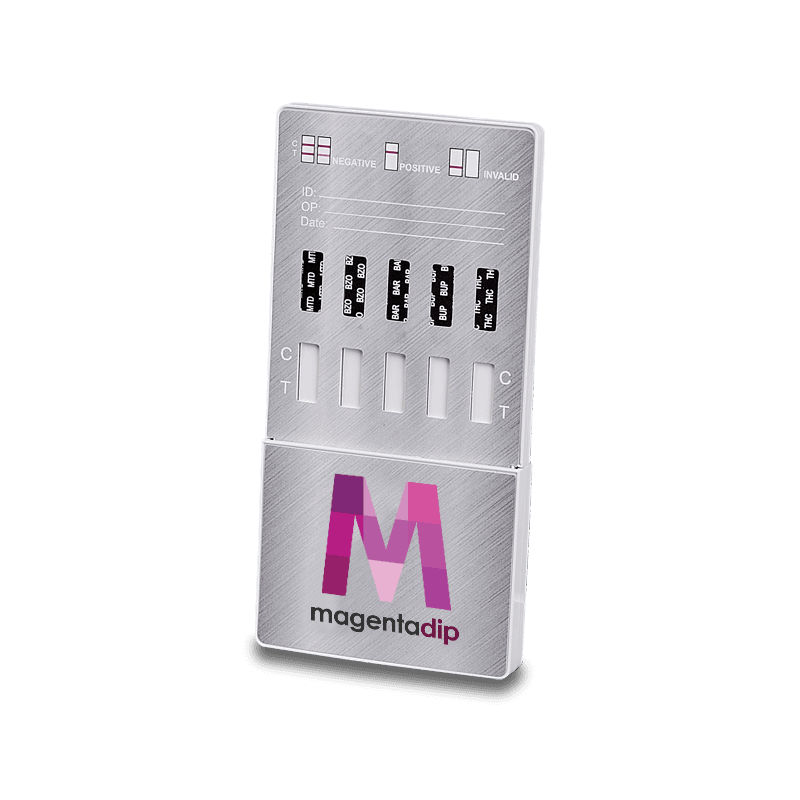
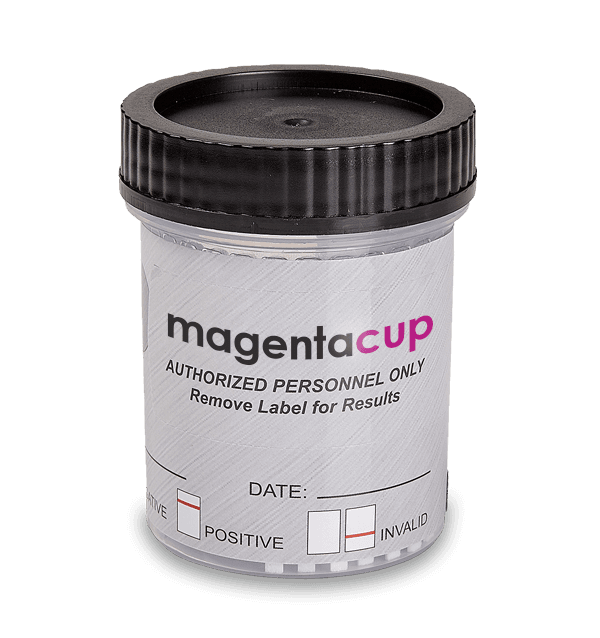
Magenta supplies educational institutions with the cup lineup and operational structure that fits both small high-school athletic-department programs and large university procurement processes. Our 5-panel and 10-panel CLIA-waived dip cards are the most cost-effective options for routine student-athlete random testing — covering the SAMHSA-5 (5-panel) or SAMHSA-5 plus benzodiazepines, methadone, oxycodone, MDMA, and barbiturates (10-panel). The 12-panel CLIA-waived cup is used by programs that want broader coverage with adulterant detection on the same cup.
Schools considering fentanyl-inclusive panels — increasingly common at universities given the visibility of fentanyl-related student deaths — can move to our 13-panel cup with fentanyl. Note that broader panels increase per-test cost and may exceed what's appropriate for the testing context (a voluntary high-school program for non-athletic students may not need a 13-panel; a Division I athletic department testing for both NCAA-banned substances and student-safety may want broader coverage). Panel design should match the documented purpose of the testing program.
On the operations side, we make wholesale pricing accessible to small school athletic departments and supportable through university procurement. There is no minimum to open a wholesale account — the first tier kicks in at 100 units. NET 30 invoicing is standard on approved school accounts. For school districts and universities with formal procurement processes, we provide W-9, certificate of insurance, vendor questionnaires, and any other documentation purchasing offices require. For multi-campus university systems or school districts running testing across multiple high schools, sub-account billing supports per-campus consumption tracking while consolidating the invoice to the district or system.
For schools running testing through student-health services or athletic training rooms, the testing workflow benefits from chain-of-custody documentation — useful for any result that may be challenged by the student or family or that may be reported to NCAA or athletic-conference compliance. We supply chain-of-custody forms appropriate for educational-program documentation and (optionally) reference-lab confirmation through our partner network for any result warranting confirmation. The CLIA Certificate of Waiver requirement applies to schools that run cups through a clinical setting (student-health clinic, athletic training room with clinical staff); athletic-department random testing without a clinical context typically operates as athletic-program eligibility verification.
Recommended Products for Education
The panels and form factors schools & universities order most.
Compliance Considerations for Educational Testing
K-12 student drug testing operates under the Fourth Amendment constitutional framework established by Vernonia School District v. Acton (1995) and Board of Education v. Earls (2002). The Supreme Court held that public-school random drug testing of students participating in athletics (Vernonia) or competitive extracurricular activities (Earls) is permissible without individualized suspicion, given the diminished privacy expectations of student-participants, the safety concerns inherent in athletics, and the limited consequences (typically athletic-eligibility consequences rather than disciplinary or criminal). Testing of all students — including those not participating in athletics or extracurriculars — has generally been held to require individualized suspicion under existing Fourth Amendment doctrine.
K-12 testing programs should have written policies covering: the population subject to testing (athletes, extracurricular-participants, voluntary participants), the random-selection methodology, the consent procedure (typically informed parental consent and student acknowledgment), the panel composition, the laboratory-confirmation procedure for positive results, the consequences (typically tied to athletic eligibility for athlete programs, voluntary intervention for voluntary programs), and the records-handling procedure under FERPA. Many states have specific state-law overlays on K-12 testing — some states have additional protective requirements, some have specifically authorized testing programs.
Higher-education testing operates somewhat differently. NCAA-member institutions running athletic testing operate under NCAA Bylaw 31 and the NCAA's banned-substance list, which differs from typical workplace panels in including performance-enhancing substances and some prescription substances banned for athletic competition. Many athletic conferences add conference-specific testing requirements on top of NCAA. Non-athletic student testing at colleges may operate under student-conduct codes or as part of conditional-readmission requirements following a disciplinary case — these programs typically require student consent and operate under the institution's student-conduct framework.
FERPA (Family Educational Rights and Privacy Act) applies to educational records including drug-test results conducted as part of educational programs. Results are generally treated as confidential education records, with disclosure limited to school officials with legitimate educational interest, parents (for students under 18 or dependent students), and the student themselves. State-specific privacy protections may apply additional restrictions. Programs that involve health services may also be subject to HIPAA — the FERPA / HIPAA boundary in school health settings is fact-specific.
Key regulations and standards
- Vernonia v. Acton / Earls v. Bd of Ed — Supreme Court precedent on K-12 student-athlete and extracurricular random drug testing without individualized suspicion.
- Fourth Amendment — Constitutional framework for any government-school testing program — different for athletic/extracurricular vs all-students contexts.
- FERPA — Family Educational Rights and Privacy Act — drug-test results are educational records subject to FERPA disclosure restrictions.
- NCAA Bylaw 31 — NCAA-member athletic testing program requirements and banned-substance list — applies to all NCAA-member institutions.
- State-specific K-12 testing law — Many states have additional state-law requirements on K-12 testing programs — varies significantly by state.
- Title IX (for athletics) — Testing programs in athletic contexts must be applied equally across male and female athletic programs.
Educational drug testing operates under complex overlapping federal and state law that varies by institution type, age group, and testing context. This information is for general guidance only — consult qualified education-law counsel and your institution's compliance office for specific requirements.
"Educational institutions consistently tell us the same thing: athletic departments and student-health offices typically buy small lots of cups at near-retail pricing through facilities or athletics budgets because they don't realize wholesale options exist for their volume. The first conversation with a procurement officer is usually a 30 to 50 percent per-cup savings on existing volume, plus NET 30 terms that fit how the district or university actually procures."
Frequently Asked Questions
Can K-12 schools legally drug test students?+
Yes, in defined contexts. The Supreme Court has held that public-school random drug testing of students participating in athletics (Vernonia, 1995) or competitive extracurricular activities (Earls, 2002) is permissible without individualized suspicion. Testing of all students — including those not in athletics or extracurriculars — generally requires individualized suspicion. Many K-12 testing programs are athletic-participant or extracurricular-participant programs operating under the Vernonia / Earls framework. Voluntary parent-consent testing for non-athlete students is also done at some schools. Consult education-law counsel and your district's compliance team on specific program design.
What panel should a school athletic program use?+
Most K-12 athletic programs use a 5-panel or 10-panel CLIA-waived dip card. NCAA-member college athletic programs typically use broader panels that include NCAA-banned performance-enhancing substances and prescription substances banned for competition — these often require specialty panels or reference-lab testing beyond standard workplace cups. Schools should match panel composition to the documented purpose of the testing program; broader panels increase cost and may not be appropriate for all educational contexts.
Do we need a CLIA Certificate of Waiver?+
It depends on the testing context. Schools that run cups through a clinical setting — student-health clinic, athletic training room with clinical staff providing healthcare services — operate under CLIA and need a current Certificate of Waiver. Athletic-department random testing operating purely as athletic-eligibility verification, without clinical staff and without clinical decision-making, generally operates as athletic-program eligibility testing rather than clinical testing. The line is fact-specific; consult your institution's compliance office.
How do we handle a positive result?+
That's a policy-design decision but the typical framework involves laboratory confirmation of the instant-cup presumptive positive (GC-MS or LC-MS-MS at a CLIA-certified reference lab), MRO review, parental notification (for K-12) or student notification (for higher ed), and an intervention sequence that typically emphasizes treatment-referral options rather than purely punitive responses. Consequences are typically tied to athletic eligibility or program participation rather than academic standing. The policy should specify the procedure clearly in the published handbook.
Do you work with school district procurement?+
Yes. We provide W-9, certificate of insurance, vendor questionnaires, and any other documentation your school district or university procurement office requires for vendor onboarding. NET 30 invoicing is standard on approved educational accounts. For multi-school districts or multi-campus universities, sub-account billing supports per-school consumption tracking with consolidated district-level invoicing.
Is fentanyl on the panel?+
Not on the standard 5- or 10-panel — fentanyl is on our 13- and 14-panel cups. Universities increasingly include fentanyl on the panel given the visibility of fentanyl-related student deaths. K-12 programs typically use the standard 5- or 10-panel; the appropriateness of fentanyl-inclusive testing in K-12 contexts is a policy decision for the district and is typically considered in districts with documented student fentanyl-exposure incidents.
What about FERPA on the test results?+
Drug-test results conducted as part of an educational program are educational records under FERPA and are subject to FERPA's disclosure restrictions — accessible to school officials with legitimate educational interest, parents of students under 18 or dependent students, and the student themselves. Disclosure beyond that requires consent or one of FERPA's specific exceptions. Your district or institution's FERPA officer can advise on the specific records-handling procedures appropriate for your testing program.
What's the minimum order quantity?+
There is no minimum to open a wholesale account. Tiered pricing kicks in at 100 units of a SKU and scales at 500 and 1,000+. Most high-school athletic-department orders qualify for the first wholesale tier on their first annual order; large university systems typically qualify for the second or third tier.
Ready to Stock Your Athletic Program?
Wholesale pricing accessible at K-12 athletic-department volumes and university-procurement scale, with NET 30 terms and FERPA-compatible documentation.
Related Industries
Workplace HR
Pre-employment, random, and post-incident testing supplies for businesses of any size.
Explore →Law Enforcement
Pre-employment, fitness-for-duty, and intake testing supplies for police, sheriff, and corrections agencies.
Explore →Rehab Centers
High-volume monitoring with chain-of-custody options for residential and outpatient treatment programs.
Explore →Government & Military
Federal Drug-Free Workplace Program supplies for government agencies, contractors, and military commands.
Explore →